Lincoln Park: A Century of Golf Above the Golden Gate
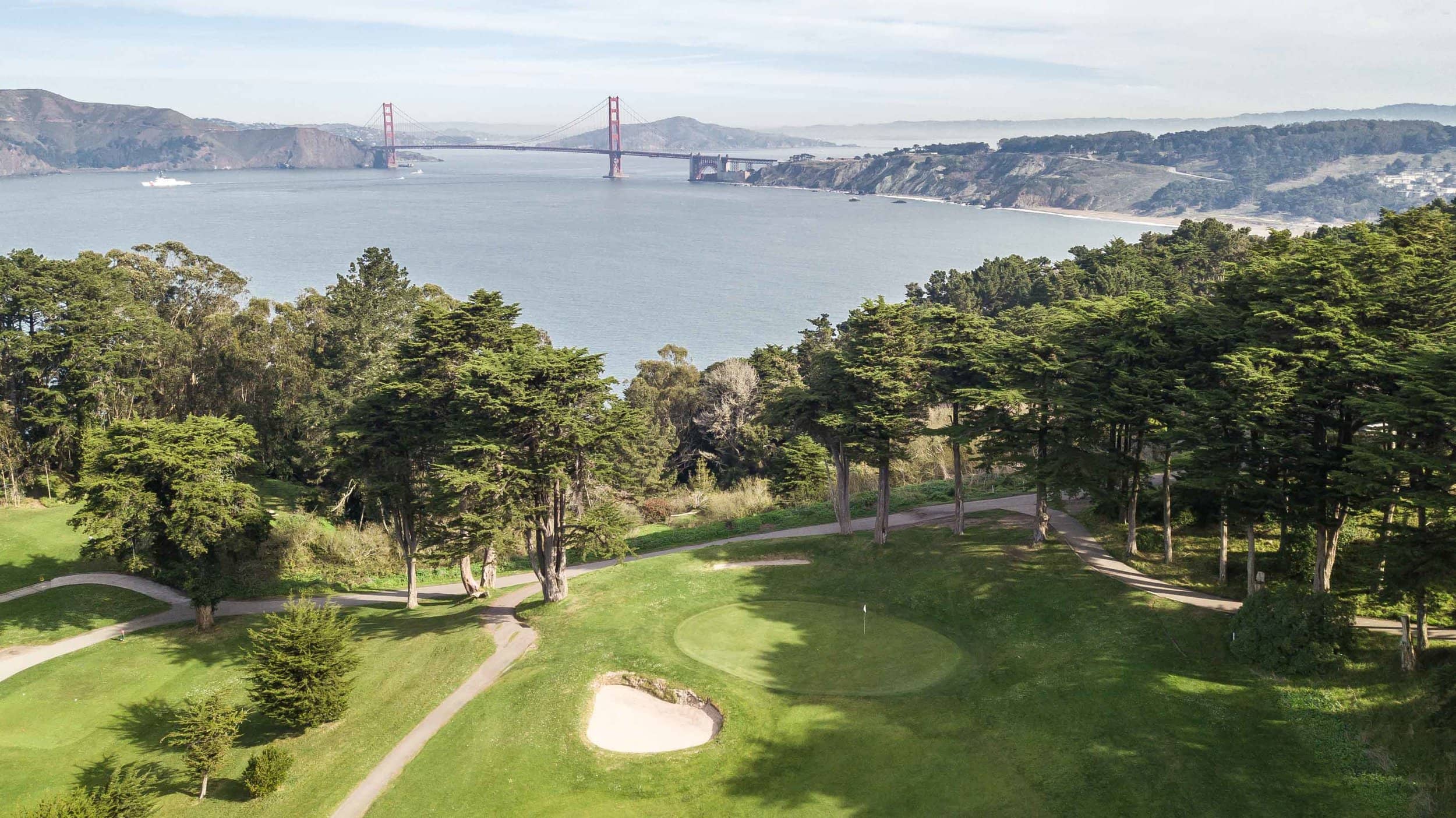
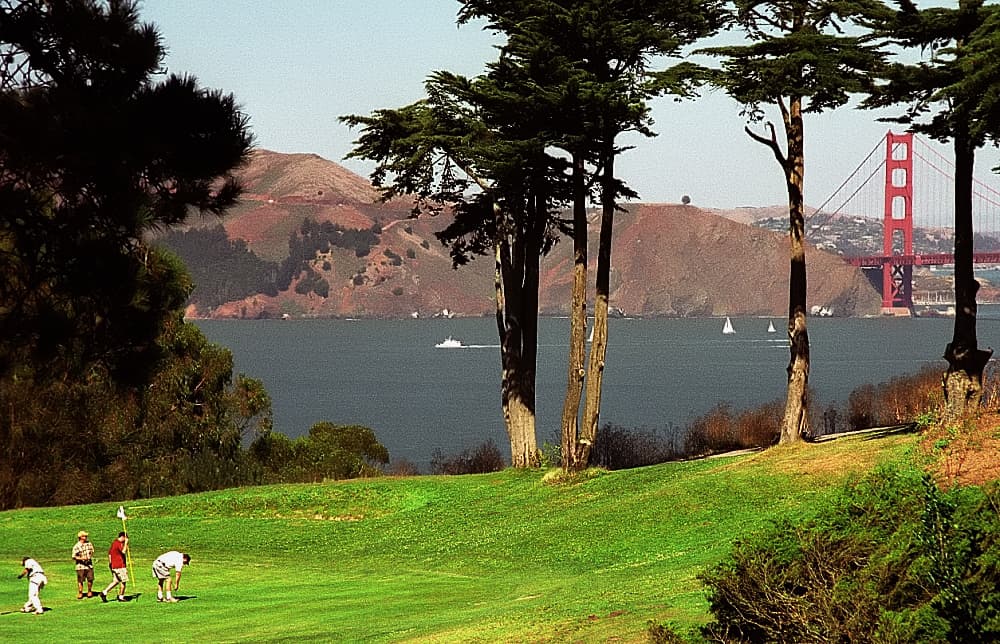
Stand on the 17th tee at Lincoln Park Golf Course on a clear morning and you get one of the most photographed views in public golf: the Golden Gate Bridge framed between cypress trees, the Marin Headlands beyond, the Pacific crashing against Land's End below. It is a 240-yard par 3 that golfers have been photographing since before there was a bridge to photograph — historic postcards of the hole predate the span itself.
But the view is only half the story. Lincoln Park is San Francisco's original municipal golf course, among the oldest public courses in the American West, the birthplace of the San Francisco City Championship, and — beneath every fairway — the resting place of thousands of San Franciscans whose graves were never moved.
Before the Fairways: City Cemetery, 1868–1909
The headlands above Land's End were never supposed to be a park. In 1868, San Francisco set aside a broad stretch of windswept ground at the city's far northwestern corner as a municipal burying ground — known variously as City Cemetery, Golden Gate Cemetery, and Potter's Field. The first recorded interment came in July 1870.
City Cemetery was the city's public burying ground: a potter's field for San Francisco's poor and indigent, alongside sections purchased and maintained by the city's immigrant benevolent and fraternal associations. By 1887 it held more than 11,000 interments, including over 4,000 Chinese burials; by 1893 the total had reached 18,000, more than 11,000 of them poor and indigent San Franciscans laid to rest in the potter's field. The association sections included the Chinese Six Companies, French, German, Italian, Russian, Jewish, Greek Orthodox, Japanese, and Slavonic societies, along with Civil War veterans of the Grand Army of the Republic and a plot maintained by the Ladies' Seamen's Friend Society for sailors who died far from home. In 1893, the U.S. Army purchased 54 acres of the cemetery grounds for the adjacent military reservation that became Fort Miley — 16 years before there was a park here at all.
The city closed the door on all of it around the turn of the century. New burials were banned, and in 1901 the Board of Supervisors prohibited interments anywhere within city limits. In 1909, the supervisors transferred roughly 150 acres of the cemetery land to the Parks Commission and named the new park in honor of President Abraham Lincoln. Officially, the graves were exhumed and relocated to Colma. In practice, the removals were incomplete on a staggering scale: researchers estimate that 10,000 to 20,000 people remain buried beneath the golf course today.
Two structures from the cemetery era still stand on the course — remnants that survived the clearance: the Kong Chow Association's traditional funerary altar near the 1st hole, and the Ladies' Seamen's Friend Society's bronze obelisk near the 15th. In September 2022, San Francisco officially designated the City Cemetery site a city landmark — the first archaeological landmark in San Francisco history — through legislation introduced and championed by Supervisor Connie Chan and supported by community members, including the Kong Chow Benevolent Association.
Golf Arrives Before the Park
Golf arrived before the cemetery had even been cleared. In 1902 — or 1903, depending on the account — years before the land officially became a park, golf enthusiasts laid out a rudimentary three-hole course on the old potter's field, making Lincoln Park among the oldest public golf grounds in the American West.
The course grew in stages through the 1910s: the links opened formally to the public in 1912, expanded mid-decade, and reached a full 18 holes in 1917. For its first 23 years, Lincoln Park was San Francisco's only municipal golf course — and in the early days it charged no green fees at all. Every public golfer in the city learned the game on these headlands until Harding Park opened by Lake Merced in 1925.
Who actually designed Lincoln Park?
Like a lot of early municipal golf, Lincoln Park's design history is a relay race rather than a single signature. San Francisco Recreation & Parks credits the course as "built in stages by several different architects," including Tom Bendelow — the Scottish-born "Johnny Appleseed of American Golf" who laid out some 600 courses across the country in the early twentieth century. Golf historians also credit Jack Neville, who would go on to co-design Pebble Beach, with the earliest holes, and English architect Herbert Fowler — the man behind Walton Heath — with a significant 1921 redesign. Later revisions came from Jack Fleming, the Irish-born superintendent who shaped nearly every municipal course in San Francisco (his story is here).
The result is a par 68 of 5,416 yards that plays far harder than the scorecard suggests: narrow cypress-lined corridors, small circular greens, hilly terrain, and the ocean wind doing the work that bunkers do elsewhere.
The Birthplace of "The City"
Lincoln Park's greatest contribution to golf isn't a hole — it's a tournament. The San Francisco City Championship was born here: the championship's own history dates its establishment at Lincoln Park to 1916, before the event moved its later rounds to Harding Park after that course opened in 1925. Lincoln Park remained the traditional site of the City's qualifying rounds for generations of San Francisco golfers.
"The City" bills itself as the oldest consecutively played golf championship in the world — it kept going straight through the wars that paused the U.S. Open and the Open Championship — and its roll of champions doubles as a history of Bay Area golf. Ken Venturi, born in San Francisco in 1931 and raised on the city's public courses, won the City in 1950, 1953, and 1956 before winning the 1964 U.S. Open at Congressional. George Archer, who would go on to win the 1969 Masters, took the City title in 1963, honing the putting stroke that made him famous on the city's municipal greens. Juli Inkster won the women's City twice before her U.S. Women's Open titles.
The 1956 final — and the ones who got away
The tournament's mythic moment came in 1956, when Venturi met defending champion Harvie Ward — then the reigning U.S. Amateur champion, who had also won the 1952 British Amateur — in the final at Harding Park. More than 10,000 spectators followed the match, and Venturi won 5 and 4. It remains the high-water mark of American municipal golf, and it grew directly out of the competitive culture that started on Lincoln Park's fairways.
Not everyone conquered The City. Johnny Miller — a San Francisco kid and 1965 graduate of Lincoln High School, the same school Venturi attended — chased the title but never won it. Neither did Tom Watson, nor Bob Rosburg, the 1959 PGA champion, who started his competitive career in the event but never took the championship. The City humbled future major champions before the tournament proper even began.
The Legion of Honor and What Lies Beneath
In 1923 the city chose Lincoln Park's highest ground as the site of the California Palace of the Legion of Honor, the fine arts museum donated by sugar magnate Adolph Spreckels and his wife Alma as a memorial to the Californians who died in the First World War. The museum — a three-quarter-scale adaptation of the Palais de la Légion d'Honneur in Paris — opened in 1924, and golfers have played around it ever since. Its plaza also marks the western terminus of the Lincoln Highway, America's first coast-to-coast road.
The museum's construction was also the first reckoning with what the golf course had covered over. Workers unearthed burials during the original 1921 groundbreaking, and again — on a much larger scale — during the museum's seismic retrofit and expansion in the 1990s. In 1994, archaeologist Miley Holman's team removed the remains of roughly 750 individuals from beneath the building, finding coffins packed, in his words, cheek by jowl; many more were left in place under the foundation. The discoveries transformed how San Francisco understands the site, and they are a large part of why the cemetery finally received landmark recognition in 2022.
It is worth saying plainly: the golfers who laid out those first holes built their course on the graves of San Francisco's poorest residents and its immigrant communities, most of whom were never moved. The 2022 landmark designation — and the memorial efforts that continue today — are the beginnings of a more honest accounting. Playing Lincoln Park with that knowledge doesn't diminish the course; it deepens it.
Lincoln Park Today: Par 68 Above the Golden Gate
More than 120 years after those first three holes, Lincoln Park is still exactly what it was built to be: genuinely public golf on land no developer could ever touch. The course remains a walkable par 68 where driver stays in the bag, the greens are small and sneaky, and the fog can turn a July morning into links weather.
Lincoln Park at a glance:
Opened: first three holes laid out in 1902 or 1903 (accounts differ); full 18 holes by 1917
Par / yardage: 68 / 5,416 yards
Architects: Built in stages — early holes credited to Jack Neville, with contributions attributed to Tom Bendelow, a 1921 Herbert Fowler redesign, and later revisions by Jack Fleming
Signature hole: the 240-yard par-3 17th, with its famous Golden Gate Bridge view
Claim to fame: San Francisco's first municipal course and the birthplace of the San Francisco City Championship (established 1916)
And the 17th tee is still the reason to come. Golfers played this bluff for more than three decades before the Golden Gate Bridge rose in the frame — proof that at Lincoln Park, even the famous view is a relative newcomer.
Lincoln Park is one chapter in a bigger story — read The History of Golf in San Francisco and The Oldest Golf Courses in the Bay Area for the rest.