Golf was invented on foot, and somewhere between the fleet of GPS carts and the 7,500-yard "championship" slog, most courses forgot that. The best walking golf courses in the Bay Area haven't. They're flat or compact, the next tee sits a few steps from the last green, and nobody looks at you sideways for carrying a bag. Walk them and you notice things a cart never shows you — the tilt of a fairway, the firmness of the turf, the way the wind actually moves.
This list is unapologetically biased toward that experience. Most of these are munis routed in an era when walking was the only option — which turns out to be the best design constraint golf ever had: short green-to-tee walks, sane yardages, terrain that lets you keep a rhythm. A few are short courses that some golfers will dismiss out of hand. Those golfers are wrong, and their loss is your ninety-minute tee time.
Every course below is open to the public, and every one has a genuine carts-optional culture. Here are nine, in order.
1. Pacific Grove Golf Links — Pacific Grove
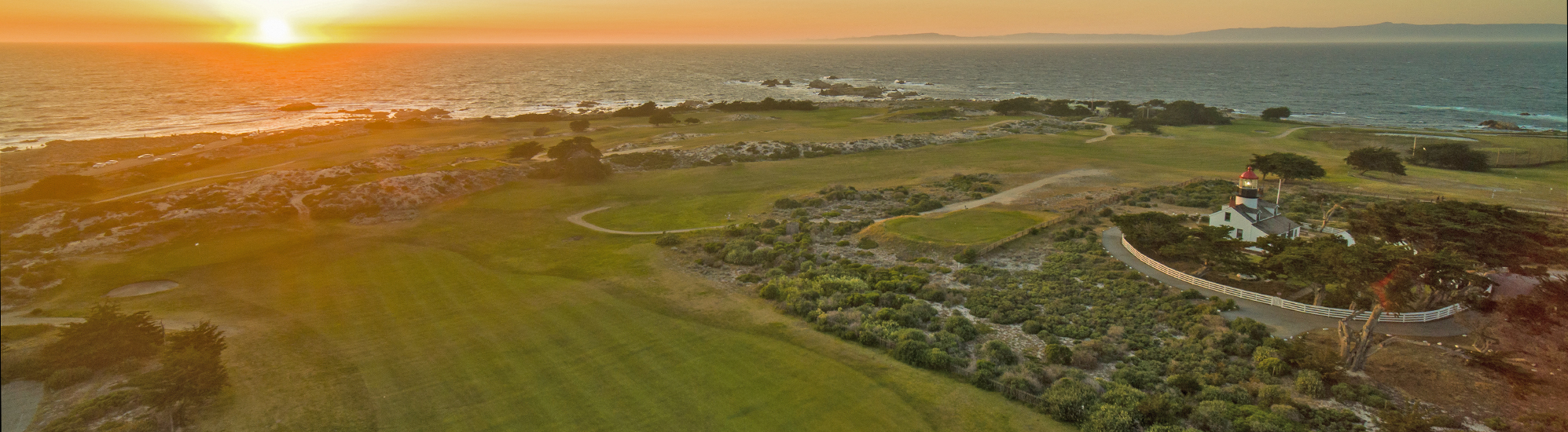
If you only walk one course on this list, walk the "Poor Man's Pebble Beach." At 5,727 yards and a par of 70, Pacific Grove is a tale of two nines you feel in your legs and your grin: H. Chandler Egan's sheltered 1932 front through the Monterey pines, then Jack Neville's 1960 back nine breaking onto open linksland around the Point Pinos Lighthouse. It's genuine seaside golf at a city-muni price, and the compact routing means the walk is part of the reward, not a tax on it.
2. Sharp Park Golf Course — Pacifica
Alister MacKenzie's only public oceanside design in the United States is a San Francisco-owned muni in Pacifica, and it walks the way a 1932 seaside links should. Wide, rolling fairways offer multiple routes to the green, so the stroll doubles as strategy time — you pick your line as you go. At 6,481 yards and par 72, with the Pacific breeze as the defining variable, it's the rare round where carrying a bag makes you feel like a participant in the golden age of design rather than a throwback.
3. Golden Gate Park Golf Course — San Francisco
Nine par 3s, 1,302 yards, two blocks from Ocean Beach — walking golf distilled to its essence. Jack Fleming laid it over natural sand dunes in 1951, and the 2023 renovation by Jay Blasi rebuilt and enlarged the greens while adding multiple tee options on every hole. There's no cart to skip because there's no reason one should exist here: carry a half set, play it in about the time a parkland course takes to clear its first backup, and leave with a sharper short game.
4. Lincoln Park Golf Course — San Francisco
San Francisco's oldest city-owned course, dating to 1902, is a compact par 68 across the hills above Lands End — 5,416 yards of shotmaking with the Golden Gate Bridge waiting at the par-3 17th. Yes, there's elevation change, but the routing is tight and the walk is the whole point: the views of the bridge, the ocean, and the downtown skyline open up on foot in a way no cart path frames. Bring layers, walk it, and let the scorecard take care of itself.
5. Mill Valley Golf Course — Mill Valley
Marin County's oldest course, organized in 1919, is nine holes, par 33, and 2,140 yards threaded through hills, creeks, and mature redwoods at the base of Warner Canyon. The gentle terrain and short length make it the most serene walk on this list — closer to a hike with golf clubs than a grind. City-run, unhurried, and ideal for beginners, families, or anyone who wants an hour of golf without ceremony.
6. Gleneagles GC at McLaren Park — San Francisco
The honest-test pick. Jack Fleming's 1962 nine at McLaren Park is compact but tilted — hardly a level lie anywhere, narrow fairways, small fast greens — and it's often called one of the toughest nine-hole tests in America. Walk it twice from alternate tees for a full 18 and you've earned the sweeping views of the city and the bay. Not the flattest walk here, but pound for pound the most golf per step in San Francisco.
7. Poplar Creek Golf Course — San Mateo
The Peninsula's everyday walking course. Built in 1933 as the San Mateo Municipal Golf Course and fully redesigned for its 2000 reopening, Poplar Creek is relatively flat, tree-lined, and honest at 6,035 yards and par 70. It hosts more than 75,000 rounds a year, which tells you the locals figured out what it is long ago: a dependable, walkable loop where accurate positioning beats raw distance every time.
8. Baylands Golf Links — Palo Alto
Forrest Richardson's 2018 rebuild of Palo Alto's 1956 muni turned a flat bayside site into a true links — wrinkled fairways, sod-faced pot bunkers, even a shared double green — and links golf is walking golf, full stop. The firm seashore paspalum turf and near-constant wind off the Bay demand the ground game, and you read that ground best at walking speed. At 6,680 yards and par 72, with five par 3s and five par 5s, it's the most architecturally interesting walk in Silicon Valley.
9. Del Monte Golf Course — Monterey
The oldest course in continuous operation west of the Mississippi, opened in 1897 to a Charles Maud design, is a living record of what golf looked like when everyone walked. Gentle, tree-lined terrain, small firm greens, and a compact routing make this Pebble Beach Resorts parkland an ideal walk at 6,365 yards and par 72. It rewards positioning and short-game touch over power — turn-of-the-century strategy at a fraction of its coastal neighbors' price.
How to pick your walk
For pure scenery on foot, it's Pacific Grove and Lincoln Park. For architecture, walk Sharp Park and Baylands and watch the ground do the work. Short on time? Golden Gate Park and Mill Valley deliver a real round inside ninety minutes, and Gleneagles packs a full round's worth of test into nine holes. For a steady everyday loop, Poplar Creek and Del Monte are the courses you'll walk fifty times and never resent. Wear real shoes, carry light, and skip the cart line entirely.