How Harding Park Was Saved: The Restoration That Brought Majors Back
In June 1998, the best golfers in the world came to the shores of Lake Merced for the U.S. Open at the Olympic Club. Next door, one of America’s great municipal courses played a humbler role: Harding Park — the course where Ken Venturi learned the game and Byron Nelson tuned up for the greatest streak in golf history — was rented out as a parking lot. Under a deal the San Francisco Chronicle reported at about $200,000, the USGA parked up to 7,000 cars a day on the fairways of Harding and its nine-hole sibling, Fleming, while shuttle buses ferried spectators to the championship next door.
“We think it’s the dumbest idea we’ve ever heard,” George Keefe of the Harding Park Men’s Club told the Chronicle at the time. Even the city’s golf director, Bob Killian, admitted he was “sort of horrified at first” — though he came around to the plan once the USGA agreed to route most of the cars onto the Fleming layout and to repair any damage the parking caused.
It was the low point in the life of a course that Ken Venturi remembered, from his youth, as “as good as any country club around.” But even as the cars rolled in, a comeback was quietly taking shape — one that would bring the PGA Tour back to Lake Merced and, for the first time in the course’s history, deliver a Presidents Cup and a major championship to a city-owned muni where residents still tee it up at a discount.
A $300 Design on the Shore of Lake Merced
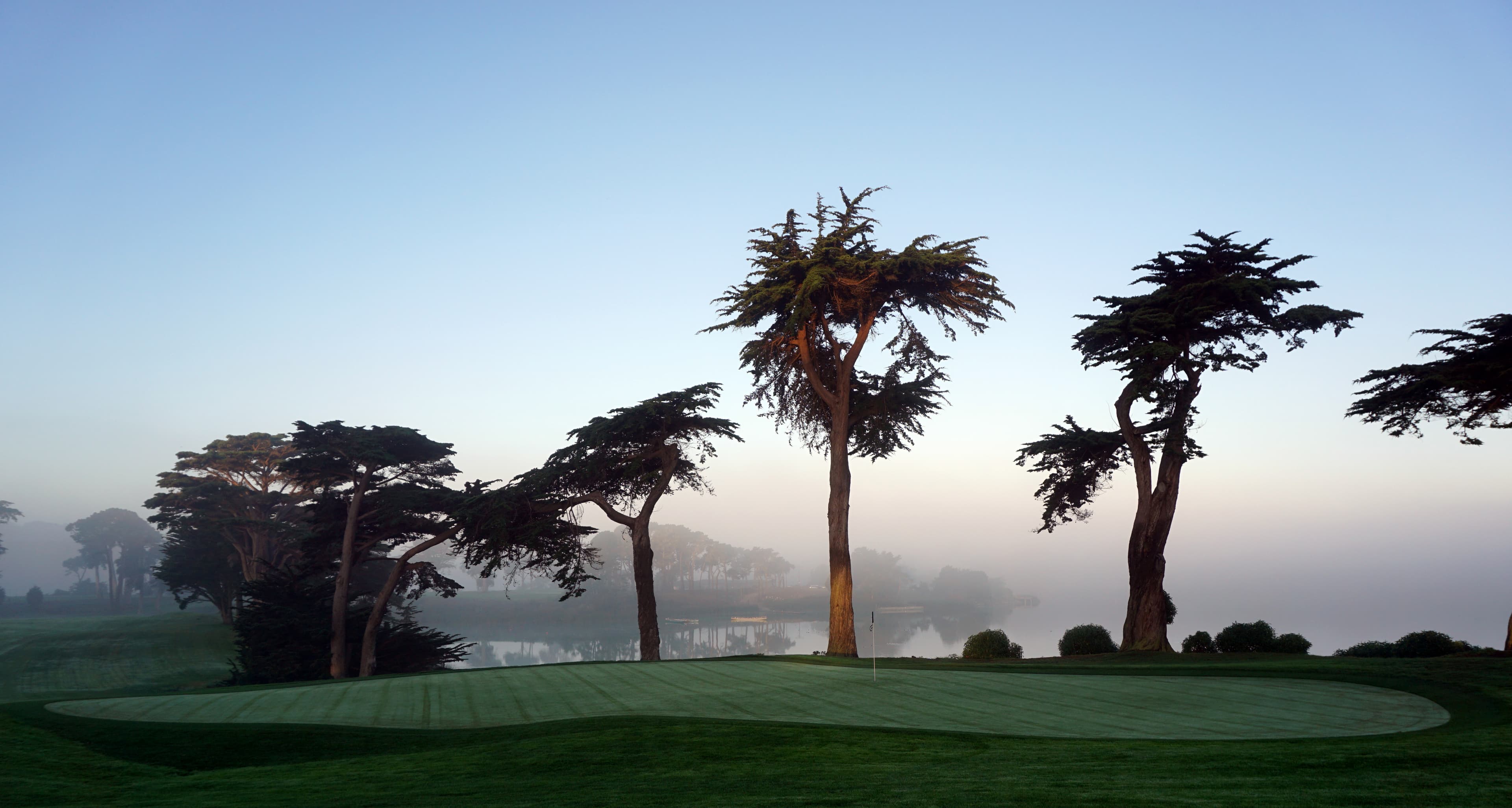
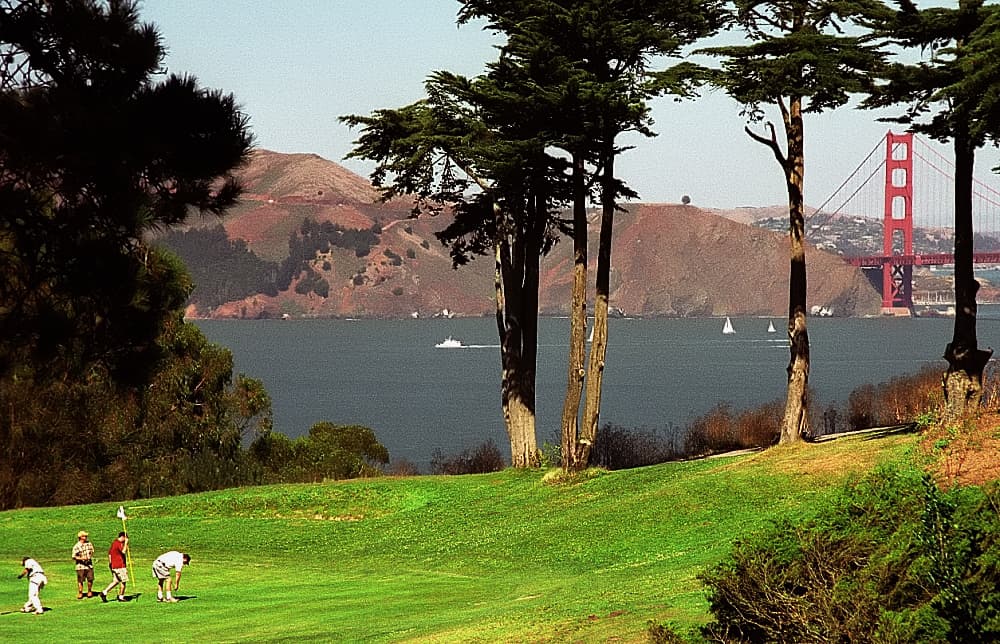
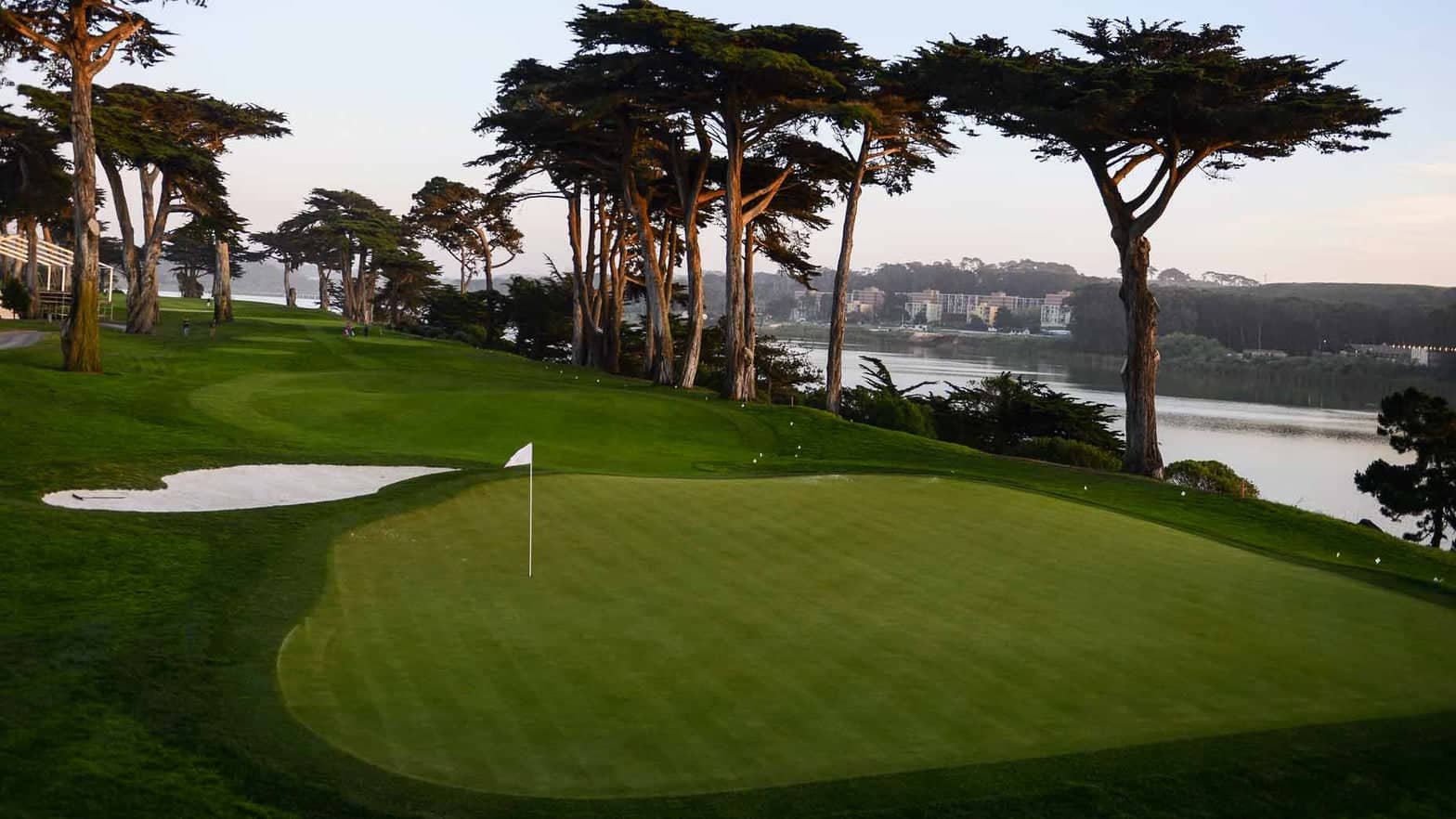
Harding Park opened on July 18, 1925, on a foggy, cypress-lined peninsula jutting into Lake Merced in the city’s southwest corner. The design came from Willie Watson and Sam Whiting — the same team that laid out the neighboring Olympic Club’s Lake Course — and their fee for drawing up the plan was exactly $300. Construction cost roughly $295,000, and the course was named for President Warren G. Harding, an avid golfer who had died at San Francisco’s Palace Hotel in 1923, less than two years before the first tee shot.
The routing was distinctive from the start, and it still is: the front nine tucked inside, the back nine wrapping the perimeter of the peninsula until the closing holes run hard against the lake. Sandy Tatum — a Stanford golfer in the late 1930s who would loom large in this story decades later — called the finishing stretch “one of the most exhilarating experiences” in golf.
When Harding Was the Center of Bay Area Golf
For decades, Harding Park was a genuinely big-time venue. The USGA brought the U.S. Amateur Public Links Championship there in 1937 and again in 1956. Byron Nelson won two events at Harding in 1944, a springboard to his legendary 1945 season and its 11 consecutive PGA victories.
Venturi, Ward, and the most famous City final
Harding’s beating heart, though, was an amateur event: the San Francisco City Championship, the great democratic tournament that has called the course home for generations. Its most famous chapter came in 1956, when San Francisco’s own Ken Venturi met Harvie Ward — the reigning U.S. Amateur champion — in the final. The match drew a gallery of 10,000, and Venturi’s victory made the front page of the next day’s newspapers, ahead of the sports section.
Venturi was Harding Park’s homegrown son in the fullest sense. He grew up in the Ingleside District near the 12th hole, played his first round there with hickory-shafted clubs bought across the street, and his father Fred later ran the Harding pro shop for years. Venturi went on to win the 1964 U.S. Open, and in January 1966 he closed out his PGA Tour career with his 14th and final victory — at Harding Park, in the Lucky International Open.
The Lucky International years
That tournament, backed by Lucky Lager Brewing Company owner Eugene Selvage, made Harding a regular PGA Tour stop from 1961 through 1969. The champions’ list reads like a wing of the Hall of Fame: Gary Player won the 1961 edition, Chi-Chi Rodríguez beat Don January in a 1964 playoff, Venturi took his hometown title in 1966, and Billy Casper won in 1968 with a tournament-record 269.
The Long Decline
Then the money ran out. The Tour left after the 1969 San Francisco Open Invitational, driven off in part by deteriorating conditions and cramped, antiquated facilities. City budget cuts through the 1970s and 1980s gutted maintenance, and the once-immaculate muni slid into decades of neglect. The fairways filled with weeds and daisies — tour pro Michael Allen described the signature Harding experience as striping a drive down the middle and never finding the ball. Scott McCarron remembered playing a City Championship on 17 temporary greens, just circles of white paint in the fairways, because the real greens were unplayable. Future supervisor Sean Elsbernd, who learned the game at Harding and Fleming, remembered ugly yellow aluminum benches still carrying graffiti scrawled in the ’60s and ’70s.
By 1998, the course that had hosted Nelson, Player, and Venturi was worth more to championship golf as parking. But the same Chronicle story that recorded the indignity showed a revival already stirring: PGA Tour commissioner Tim Finchem had floated the idea of bringing the Tour Championship to Harding — if somebody could find the $10 million to $15 million in improvements that studies said the course needed — and private operators were already circling the course.
Sandy Tatum’s Crusade
The somebody was Frank “Sandy” Tatum Jr., the San Francisco attorney, Stanford NCAA champion (1942), and former USGA president (1978–80) who had helped bring U.S. Opens to the Olympic Club and Pebble Beach. Tatum had been playing in the City Championship at Harding since his college days — he entered roughly 40 times — and he made the restoration of the course his personal mission.
The first attempt nearly killed the whole idea. Tatum won Mayor Willie Brown’s backing for a plan under which Arnold Palmer Golf Management, a private Florida-based operator, would renovate and run the course. But privatizing a beloved public course provoked a fierce backlash — under the plan, non-resident fees were projected to approach $200 a round — and when the company and the city couldn’t agree on a fee schedule guaranteeing residents reduced-rate tee times, Palmer Golf walked away. In 2001, the Board of Supervisors rejected privatization for good.
What emerged instead was a genuinely municipal solution. Rookie supervisor Tony Hall, working with Tatum and the city attorney’s office, helped assemble a public renovation plan — championship tees stretching the course from 6,743 to about 7,200 yards, a new clubhouse, a rebuilt driving range, a renovated Fleming nine, a youth learning center, and a dedicated golf fund for ongoing maintenance — with green fees kept affordable for residents, seniors, and kids. The funding leaned on Proposition 12, the statewide parks bond passed in 2000, and in 2001 the Board of Supervisors unanimously approved using the money. In exchange, the PGA Tour committed to bringing big-time golf back to Lake Merced.
Fifteen Months That Changed Everything
Construction began in the spring of 2002. Fifteen months and $16 million later, on August 22, 2003, Harding Park officially reopened. Mayor Brown declared it “the finest municipal golf course in the land,” 120 lottery-selected golfers played the first rounds, and the ceremony ended with the unveiling of a boulder beside the first tee bearing a plaque: “San Francisco honors Frank ‘Sandy’ Tatum, Jr. for his invaluable gift to The City — the renaissance of a treasured jewel, Harding Park Golf Course.”
Tatum, then 83, stood before it in tears. “I’m trying to hold it together, but I can’t,” he said. “There’s no place else in the world I’d rather have that.”
Big-Time Golf Comes Back
The payoff came fast.
2005: Tiger and Daly go to extra holes
In October 2005, Harding hosted the WGC–American Express Championship — its first PGA Tour event since 1969. It got a finish worthy of the wait: Tiger Woods and John Daly tied at 10-under 270, and Woods won on the second playoff hole when Daly missed a two-foot par putt. It was Woods’s tenth World Golf Championships title.
2009: The Presidents Cup
Four years later the Presidents Cup came to town — the first ever held at Harding — with Fred Couples’s American side beating Greg Norman’s Internationals 19½–14½. Woods went a perfect 5–0–0, closing out Y.E. Yang 6 and 5 in Sunday singles.
TPC Harding Park
On November 3, 2010, the course joined the PGA Tour’s TPC network — becoming TPC Harding Park — with PGA Tour Golf Course Properties operating the course without a management fee while the city retained ownership. Champions Tour Charles Schwab Cup Championships followed in 2010, 2011, and 2013, and the WGC Match Play arrived in 2015.
2020: A major, at last
The summit came in August 2020, when Harding Park hosted the PGA Championship — the first men’s major ever contested on the course. Postponed from May by the COVID-19 pandemic and played without spectators, it produced a storybook local result anyway: 23-year-old Collin Morikawa, who had starred collegiately across the Bay at Cal, closed with a 64 — tying the record for the lowest final round by a PGA Championship winner — and drove the green for eagle at the short par-4 16th to win his first major at 13-under 267, two clear of Paul Casey and Dustin Johnson.
The People’s Course, Still
Sandy Tatum died in 2017 at 96, three years before the major he made possible. His boulder still sits by the first tee, and the course it commemorates remains what it always was: a city-owned muni, run for the public, with a substantial green-fee discount for San Francisco residents and the friendly Fleming 9 — named for longtime city parks superintendent John Fleming — alongside.
That’s the real lesson of the Harding Park restoration. Plenty of American cities let their great Golden Age munis rot, and a few sold them off. San Francisco nearly did both. Instead, a retired USGA president, a rookie supervisor, and a lot of stubborn public golfers proved that a championship course and a people’s course can be the same piece of ground — the same glorious grass where a kid from the Ingleside once learned the game, and where the next one is probably teeing off this morning.
For more on the man behind the comeback, read Sandy Tatum: The Man Who Saved Harding Park, or zoom out with our full history of golf in San Francisco.