George Archer: The Masters Champion

On the afternoon of April 13, 1969, a six-foot-five-and-a-half-inch former ranch hand from the San Francisco Peninsula closed with a final-round 72 at Augusta National and won the Masters by a single stroke, holding off Billy Casper, Tom Weiskopf and George Knudson. George Archer's victory that Sunday made him a major champion — and it completed the Bay Area's golf story in a way few people noticed at the time.

The region had already produced major winners. Ken Venturi, raised on San Francisco's public courses, had won the U.S. Open; Bob Rosburg and Harvie Ward, out of the Olympic Club, had claimed the PGA Championship and back-to-back U.S. Amateurs; Tony Lema, from the East Bay, had lifted the Claret Jug at the Open Championship. The green jacket was the prize still missing — and Archer, whose path ran through a caddie yard in San Mateo, a cattle ranch in Gilroy and the public fairways of Harding Park, was the one who brought it home.

A San Francisco Beginning

George William Archer was born in San Francisco on October 1, 1939, and raised just down the Peninsula in San Mateo. At six feet five and a half inches, he was built for basketball, and that was his first athletic love at San Mateo High School — until golf, which he had discovered working as a caddie at the Peninsula Golf and Country Club near his home, took over his time and cost him his spot on the team.

The caddie yard proved the better classroom. Archer learned the game by carrying other people's bags, watching good players, and grinding out a self-taught swing on whatever ground would have him. Nobody looked at the gangly teenager folding himself over a putter and predicted greatness. That would become a theme.

The Gilroy Cowboy

Archer's unlikeliest apprenticeship came not on a golf course at all but on a cattle ranch. As a young man he took summer work at the Lucky Hereford Ranch in Gilroy, at the southern end of the Bay Area, owned by Eugene Selvage — the head of the Lucky Lager Brewing Company. The ranch job earned Archer the nickname that followed him for the rest of his career: "the Gilroy Cowboy."

Selvage became Archer's friend and sponsor. It was a very San Francisco arrangement — a local brewery magnate backing a Peninsula caddie — and it would pay off in the most poetic way imaginable a few years later.

Proving It at Harding Park

Before Archer could be a champion anywhere else, he had to be one at home, and in San Francisco that meant one thing: the San Francisco City Championship. Inaugurated in 1916 with the opening of Lincoln Park — the event bills itself as the oldest consecutively played golf competition in the world — "the City" was the proving ground for every serious Bay Area amateur, the stage where Venturi and Harvie Ward had waged their famous mid-1950s duels in front of thousands at Harding Park.

Archer claimed his own place in that lineage by winning the San Francisco City Championship in 1963. The same year he won the Trans-Mississippi Amateur, one of the country's premier amateur titles, and added Northern California Open honors in 1963 and 1964. The résumé was complete. In 1964, Archer turned professional.

First Win at Home: The 1965 Lucky International Open

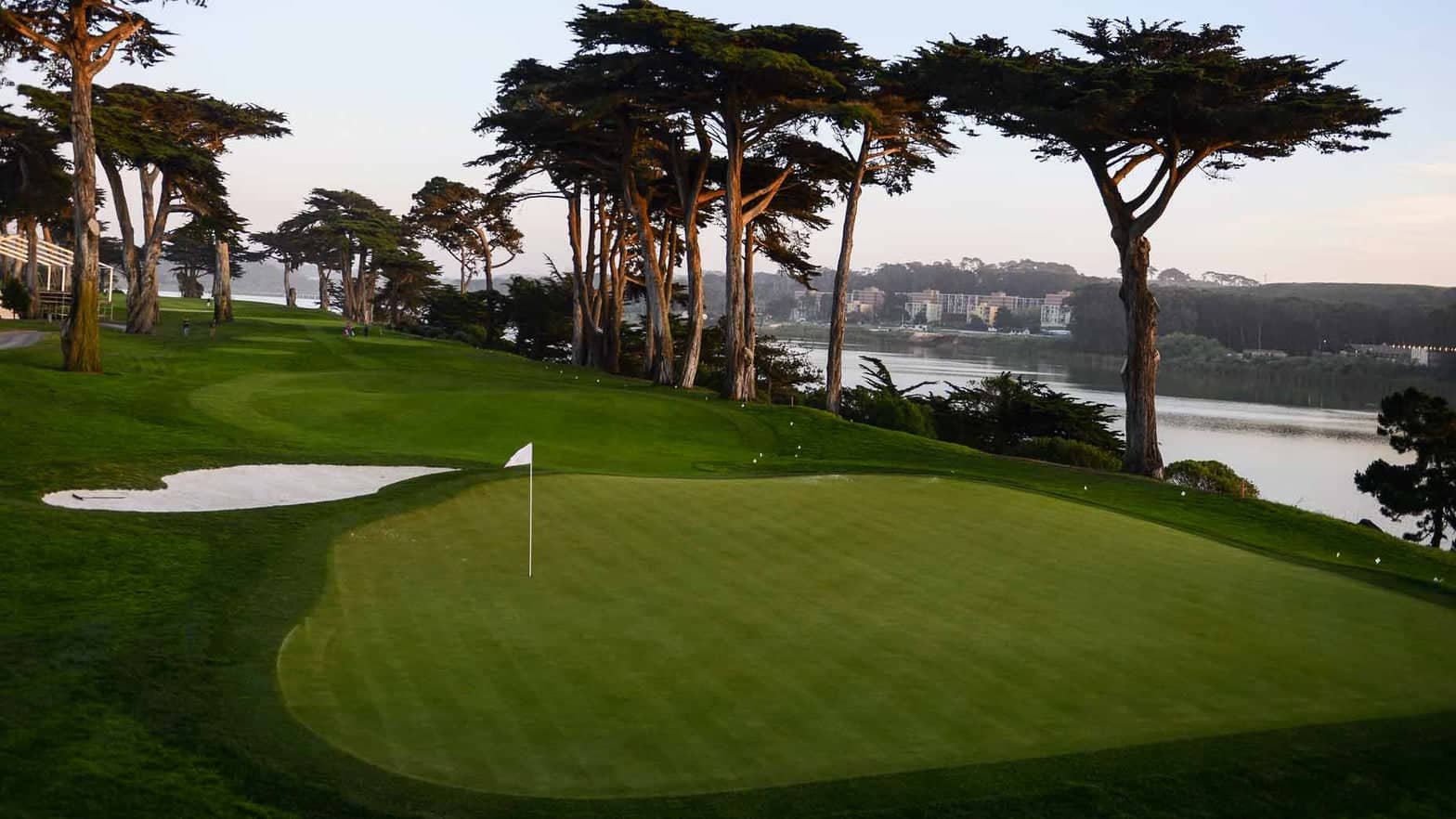
Archer's first PGA Tour victory could not have been scripted more perfectly. Beginning in 1961, the Tour made a regular stop in San Francisco for the Lucky International Open, played at Harding Park — the city-owned course that had opened on the shores of Lake Merced in 1925 — and sponsored by none other than Eugene Selvage's Lucky Lager brewery.

In 1965, in just his second season as a professional, Archer won it. He finished at 278, six under par, then beat New Zealand's Bob Charles — the 1963 Open champion — in a playoff. A San Francisco-born caddie from San Mateo, sponsored by a San Francisco brewer, winning a San Francisco tournament on the city's flagship municipal course: it remains one of the most complete hometown victories in the city's golf history.

The Tour's San Francisco stop became a remarkable index of the era's talent — six of the eight men who won it were or became major champions. The Lucky name lasted through 1968 (no tournament was played in 1967), and the Tour returned once more in the fall of 1969 for a final edition played as the San Francisco Open Invitational before deteriorating conditions at Harding Park pushed it to move on for good. The course's long decline and eventual rescue is another chapter of this story, one that belongs to Sandy Tatum.

1969: The Year of the Green Jacket

Archer built steadily through the late 1960s, adding wins at Greensboro in 1967 and at Pensacola and New Orleans in 1968. Then came 1969, and it began, fittingly, on home ground: in January, Archer won the Bing Crosby National Pro-Am on the Monterey Peninsula, a Northern California triumph that announced he was playing the best golf of his life.

Three months later he arrived at Augusta National for the Masters, played April 10–13, 1969. Archer opened with a five-under-par 67, then followed with rounds of 73 and 69 to sit at seven under, one stroke behind Billy Casper entering the final round.

Sunday belonged to attrition. Casper, the 54-hole leader, bogeyed five of his first ten holes, and Archer moved in front by three at the turn. The back nine tightened into a four-man scramble — Casper recovering, Tom Weiskopf holding a share of the lead until a bogey at the 17th, George Knudson lurking — but Archer's closing 72 held them all off. His 281 total, seven under par, beat Casper, Weiskopf and Knudson by a single stroke. The champion's share was $20,000; the green jacket was priceless.

There was a quiet Bay Area symmetry to that week, too: it was Ken Venturi's final Masters appearance. As the first great star of San Francisco's public-course scene exited Augusta, the Bay Area's newest major champion walked into Butler Cabin.

The Greatest Putter of His Generation

Archer never had a classical swing, and at his height nobody expected one. What he had was a putter, and with it he was regarded as one of the finest who ever lived. The statistical proof came at the 1980 Sea Pines Heritage, where Archer needed just 94 putts over 72 holes — an average of 1.3 per green — setting a PGA Tour record that stood for nine years until Kenny Knox broke it in 1989.

The touch traveled well. Archer won 13 times on the PGA Tour between 1965 and 1984, a career book-ended by that hometown win at Harding Park and a final victory at the Bank of Boston Classic at age 44. When he turned 50, the putter got a second career: Archer won 19 times on the Senior PGA Tour between 1989 and 2000, shared the tour's 1991 Player of the Year award with Mike Hill, and earned Comeback Player of the Year honors in 1997.

He made history off the scorecard as well. In 1983 — the first year the Masters allowed players to bring their own caddies — Archer's 19-year-old daughter Elizabeth, by then a Stanford track athlete, became the first female caddie in the Masters. She had been carrying her father's bag at Tour events since the summer of 1980, when she was still a student at Gilroy High School.

The Secret He Carried

Archer died on September 25, 2005, in Incline Village, Nevada, of Burkitt's lymphoma, six days before his 66th birthday. It was only after his death that the most astonishing fact of his life became public.

In the March/April 2006 issue of Golf For Women magazine, his widow, Donna Archer, revealed that George had been functionally illiterate his entire life — a severe learning impairment had left him able to write little more than his own name, and unable to read more than the simplest sentences. Through high school in San Mateo, through decades of contracts, courtesy-car forms, scorecards, banquet speeches and pro-am small talk, Archer had concealed it completely, with Donna quietly managing the written world around him.

Understood in that light, his career reads differently: the shyness the press took for aloofness, the discipline of a man managing far more than his golf game. In 2008 Donna established the George Archer Memorial Foundation for Literacy in Incline Village, which has held annual pro-am fundraisers in his name ever since — a Masters champion's legacy redirected toward the thing he never had.

Archer's Place in San Francisco Golf History

The history of golf in San Francisco is usually told through its most famous generation — Venturi, Harvie Ward, Bob Rosburg and Tony Lema, Bay Area products all, though only Venturi came up purely through the city's municipal courses; Rosburg and Ward played out of the private Olympic Club, and Lema learned the game across the bay in the East Bay. Between them, that generation won the U.S. Open, the Open Championship, the PGA Championship and consecutive U.S. Amateurs — and its voices, from Venturi's 35 years at CBS to Johnny Miller at NBC, Rosburg at ABC and Art Spander in print, went on to narrate the sport for the rest of the country. What none of them ever won was the Masters. George Archer fits both the story and its missing piece.

He was the caddie who out-putted the country-club kids, the ranch hand who beat Billy Casper at Augusta, the champion whose greatest performance was hiding a disability in plain sight for 65 years. And his first professional trophy was won at Harding Park, on the public fairways where San Francisco golf has always done its best work. The green jacket hung a long way from Lake Merced — but it was earned, first, right there.