The 1966 U.S. Open: Billy Casper Catches Arnold Palmer
Ask a San Francisco golfer to name the most dramatic afternoon in the city's golf history, and the answer usually comes back to a foggy stretch of cypress-lined fairway beside Lake Merced on June 19, 1966. That day, on the Olympic Club's Lake Course, Arnold Palmer — the most popular golfer alive — stood on the 10th tee of the U.S. Open's final round leading Billy Casper by seven shots. Nine holes later they were tied. A day after that, Casper was the national champion, and San Francisco had cemented its reputation as the place where golf's giants come to be humbled.
Sixty years on, the 1966 U.S. Open remains the standard against which U.S. Open collapses are measured — and, alongside Greg Norman's 1996 Masters, one of the final-round collapses against which all the others are judged. It's also a deeply local story: a championship played on a private club course inside the city limits, built into the sand hills above Lake Merced, with two Bay Area products — a San Francisco teenager named Johnny Miller and Oakland's "Champagne Tony" Lema — writing their own chapters on the same leaderboard. It remains a defining chapter in the history of golf in San Francisco.
The Stage: Olympic's Lake Course
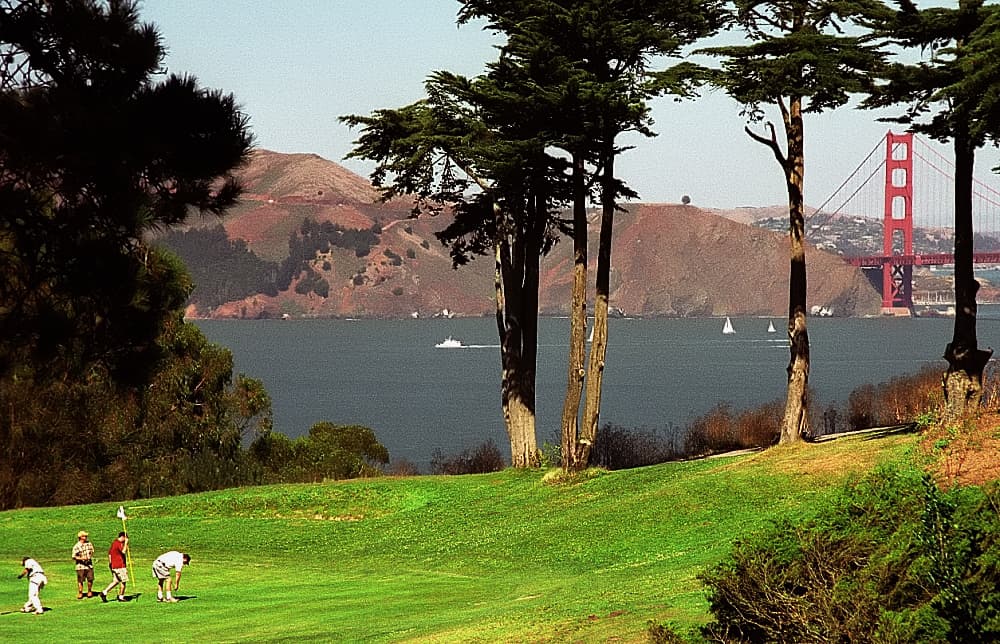
Founded in 1860, the Olympic Club is the oldest athletic club in the United States, with a downtown clubhouse on Post Street and a Lakeside campus near the Pacific that today holds three courses: the Lake, the Ocean, and the nine-hole Cliffs. The Lake Course — originally laid out by Willie Watson and remodeled and rebuilt by Sam Whiting in 1927 — is the championship venue, a claustrophobic par 70 that for the 1966 Open measured just 6,719 yards.
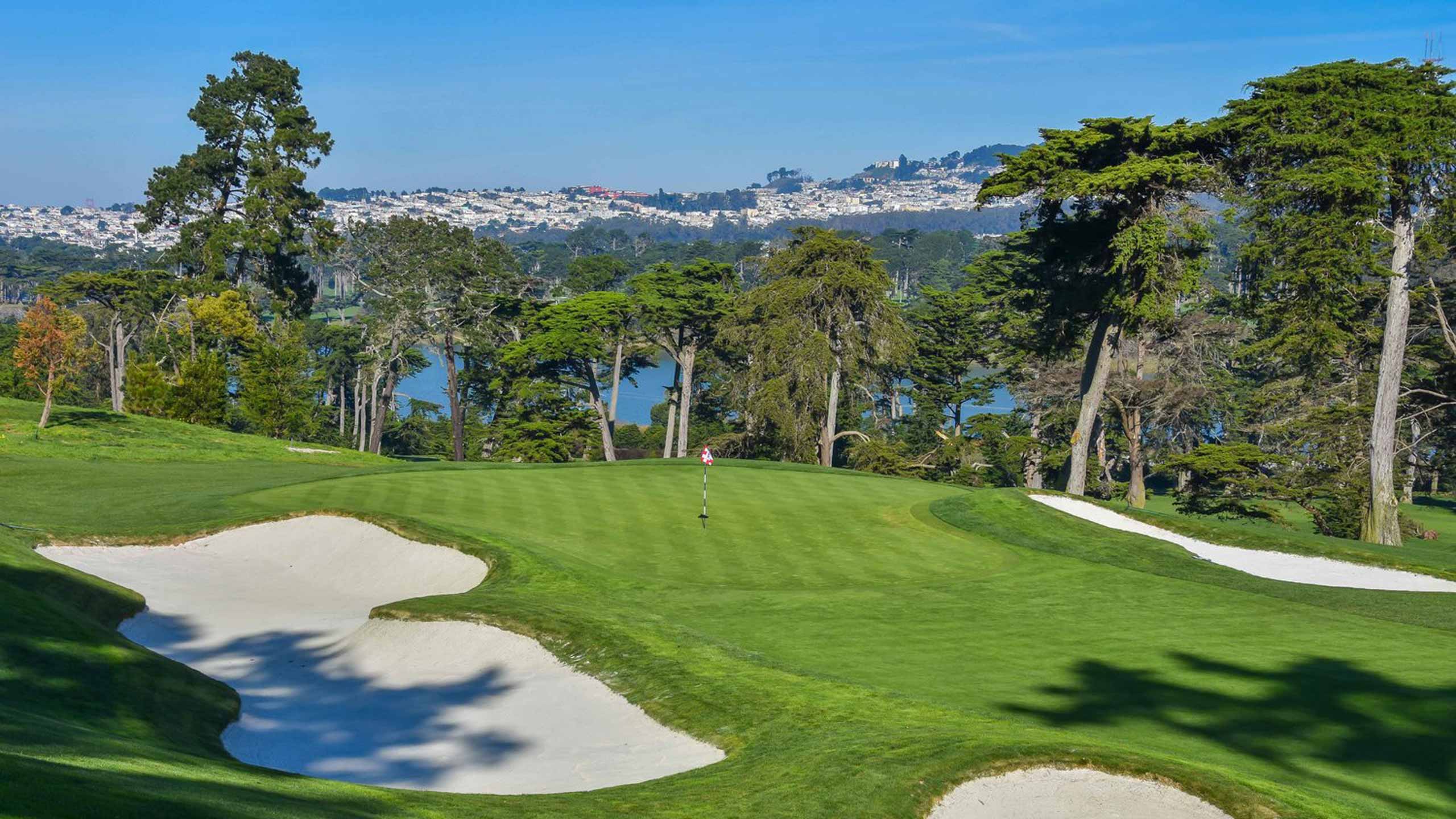
Numbers like that undersell the examination. The Lake has almost no water and few fairway bunkers; its defenses are fog-heavy air, dense rough, canted fairways that curve against the shape of the hole, and thousands of trees. And by 1966, it already had a body of work as an upset factory. Eleven years earlier, at the 1955 U.S. Open on the same course, an unknown municipal-course pro from Iowa named Jack Fleck birdied the 72nd hole to tie the great Ben Hogan, then beat him 69–72 in an 18-hole playoff — denying Hogan a record fifth Open and delivering what is still called one of the greatest upsets in the sport's history.
The pattern would only deepen: across the five U.S. Opens Olympic has hosted — 1955, 1966, 1987, 1998, and 2012 — the 54-hole leader failed to win every single time. Sportswriters took to calling the Lake Course the graveyard of champions. In June 1966, Arnold Palmer became its most famous casualty.
Palmer, Casper, and Seven Shots with Nine to Play
Palmer arrived in San Francisco as the game's defining figure — winner of seven major championships, though, as it turned out, he had already claimed his last one at the 1964 Masters. Casper arrived as the tour's great underappreciated craftsman: a San Diego caddie-yard product regarded as one of the best putters and short-game players the game had produced, a former U.S. Open champion himself from Winged Foot in 1959.
For two days they were inseparable. Both opened with rounds that left them tied at 137 after 36 holes, and Palmer's 70 on Saturday gave him a three-shot cushion over Casper, 207 to 210, heading into Sunday's final round with the two paired together.
Then Palmer caught fire. He went out in 32 against Casper's 36, and when the two walked off the ninth green, the lead was seven. The championship was, by every sensible reckoning, over. Palmer himself had moved on to a different target: Ben Hogan's U.S. Open record total of 276, set in 1948. A one-over 36 on the back nine would break it.
The Exchange on the 10th Tee
What happened next has become part of golf's oral tradition. Casper later recounted that as they made the turn he told Palmer he was simply trying to hold on to second place — and that Palmer replied he would do everything he could to help him get it. It reads like gallows humor now. At the time, it was just realism: Jack Nicklaus and Tony Lema were far behind, and Casper's only apparent competition was for runner-up.
Nine Holes That Changed Golf History
The unraveling came in increments, then all at once. Palmer bogeyed the 10th. Both men birdied the 12th, and Palmer gave another back at the 13th — still a five-shot lead. Then the Lake Course closed its fist:
15th (par 3): Casper rolled in a birdie while Palmer missed his par putt. The lead was three with three holes to play.
16th (par 5, 604 yards): Palmer, still attacking with the record gone but the title seemingly safe, hit a tree off the tee, then found deep rough and a greenside bunker before scrambling to a bogey six. Casper made birdie. One shot.
17th (par 4): Palmer bogeyed again. Tied.
18th: Both parred, Palmer holing a knee-knocking putt just to stay alive.
The arithmetic was brutal: Palmer had played the inward nine in 39; Casper had covered it in 32. Both men signed for two-under 278 — Palmer 71-66-70-71, Casper 69-68-73-68 — and the U.S. Open went to an 18-hole Monday playoff, just as it had at Olympic in 1955.
The Monday Playoff: History Repeats in Miniature
If the final round was a shock, the playoff on June 20 was an eerie replay. Palmer went out in 33 to Casper's 35 and led by two at the turn — and then the back nine happened again. Casper birdied his way in front through the middle of the round while Palmer stumbled home in 40, the fatal blow a double bogey at the same par-5 16th that had wrecked him the day before. Casper's one-under 69 beat Palmer's 73 by four.
Casper collected $26,500 for the win, including a $1,500 playoff bonus — and at the trophy presentation, in a gesture that charmed the press tent, promptly handed the winner's check to his wife. Behind the two principals, Jack Nicklaus finished third at 285, and Ben Hogan — 53 years old, playing the course that had broken his heart in 1955 — closed with an even-par round to finish 12th.
The Bay Area's Own Leaderboard
Two local storylines ran through that week, and both deserve remembering.
The first belonged to a 19-year-old San Francisco kid named Johnny Miller. Born and raised in the city, Miller had joined the Olympic Club as a junior member in 1963 and become the top player on its junior team. In 1966, as a college freshman, he qualified for the U.S. Open on his home course — and his intimate knowledge of the Lake carried him to a tie for eighth, low amateur by three shots. The finish earned him an invitation to the 1967 Masters and launched one of the great careers in American golf, including a U.S. Open title of his own in 1973.
The second is more poignant. Tony Lema — born in Oakland in 1934, raised on the caddie yards and the Lake Chabot municipal course, and by then the reigning celebrity of Bay Area golf as the 1964 Open Championship winner at St Andrews — finished tied for fourth at Olympic that week. Five weeks later, on July 24, 1966, Lema and his wife Betty died when their chartered plane crashed near Lansing, Illinois. He was buried at Holy Sepulchre Cemetery in Hayward. The 1966 U.S. Open was the last major championship top-five of "Champagne Tony's" life, delivered in front of a hometown gallery.
What It Meant
For Casper, Olympic was vindication. He would go on to win the 1970 Masters for his third major, pile up 51 PGA Tour victories — still seventh on the all-time list — win five Vardon Trophies for the tour's lowest scoring average, and enter the World Golf Hall of Fame in 1978. He had also joined the Church of Jesus Christ of Latter-day Saints in 1966, and in later years often reflected that the recognition for his career came late; being remembered mostly as the other man in Palmer's collapse understates one of the finest closing nines in championship history. He didn't just watch Palmer fall — he shot 32 on the back nine of a U.S. Open Sunday at Olympic, then closed out the King in a playoff.
For Palmer, San Francisco was the wound that never fully healed. He had famously won the 1960 U.S. Open at Cherry Hills with a final-round charge from seven shots back; at Olympic, the same margin ran the other way. It was his third playoff loss in a U.S. Open, and he never won another major after 1964. For the rest of his life, the 1966 Open remained the near-miss he was asked about most.
Olympic Since 1966
The graveyard kept collecting. Scott Simpson over Tom Watson in 1987, Lee Janzen over Payne Stewart in 1998, Webb Simpson over the field in 2012 — every U.S. Open at Olympic has ended with the 54-hole leader watching someone else lift the trophy. The big events keep coming, too: the club is set to host the 2028 PGA Championship and the 2033 Ryder Cup, the first ever played in Northern California.
The club's story off the course is more complicated than its trophy case. San Francisco's City Attorney sued the Olympic Club in 1987 over discriminatory membership practices — a suit tied to city-owned land the club used — and members did not vote to accept women until 1990. That record is part of the club's history, too, and worth remembering alongside the championships.
The Lake Course is private, but its history belongs to the whole city. Walk the public trail around Lake Merced and you can see the cypress ridgeline where, one June afternoon in 1966, seven shots vanished into the fog — and Billy Casper played the nine holes of his life.