In 1987, Dr. Gary R. Nelson won the men's club championship at Meadow Club. The victory brought an invitation to join the club's board, the sort of recognition many members would have accepted without hesitation. Nelson declined. His dental practice, teaching, and family already left too little time to do the position properly.
But he did not simply say no. Grateful to have been asked, Nelson wondered if he might serve Meadow Club another way. He had played every Alister MacKenzie course in California, and he believed their members ought to know one another. Why not invite them to Fairfax for a little golf and a serious conversation about what had happened to their courses?
That counteroffer became Gary Nelson's great contribution to golf. The meeting he organized grew into the Alister MacKenzie Society. Its research helped Meadow Club recover the bold, nearly treeless character of MacKenzie's first American design. Its preservation ethic also reached beyond private gates to Sharp Park, the San Francisco municipal course Nelson included in his very first round of invitations and later supported through the San Francisco Public Golf Alliance. Nelson did not design those courses or rebuild them with his own hands. He did something less visible and just as enduring: he helped people understand what they had, then gave them a reason to protect it.
A Doctor Drawn to Another Doctor's Work
Nelson was a third-generation San Franciscan whose life seemed to resist a single calling. He graduated magna cum laude in engineering from California Maritime Academy in 1961, spent seven years as a Merchant Marine officer, and served as a lieutenant commander in the U.S. Navy from 1968 to 1970. He earned dental degrees from the University of the Pacific and the University of North Carolina, then built a career as a prosthodontist in Marin County.
Golf was no casual diversion. Nelson competed in the U.S. and British Senior Amateur championships and won at Meadow Club, but architecture fascinated him as much as competition did. He read deeply at a time when comparatively little had been collected about MacKenzie beyond the architect's 1920 book, Golf Architecture. Nelson saw that the courses themselves held evidence, but that evidence was scattered among club archives, old photographs, plans, memories, and alterations accumulated over decades.
His solution was characteristic. He did not begin by forming an institution. He began by setting a table.
The Invitation That Became a Society
On behalf of Meadow Club, Nelson invited representatives from Pasatiempo, Green Hills, Valley Club, Northwood, Sharp Park, and Cypress Point. Pasatiempo, Green Hills, and Valley Club joined the host club for the first two-day gathering. Six-player teams mixed the club professional and champion with golfers from several handicap divisions. Dinner seating was arranged to encourage conversation. The schedule also included something unusual for an interclub golf event: a meeting about maintenance, historical evidence, and the changes each course had undergone.
The event repeated at Green Hills in 1988, then lost momentum when Pasatiempo could not secure approval to host it. A chance meeting between Nelson and Pasatiempo member Barry Staley revived the idea. Staley helped organize a larger gathering there in 1992, joined by Crystal Downs and Cypress Point. Nelson was elected president, and the group adopted a club-director structure so that every participating course would have a lasting advocate inside its own governance.
By 1995, the informal gathering had incorporated as the Alister MacKenzie Society. Its formal purpose was not merely to arrange access to famous courses. It was to locate and preserve material about MacKenzie, support scholarship, and help maintain the integrity of his original designs. Nelson would serve the organization in multiple roles—as president, historian, secretary, and adviser—as it expanded to 15 clubs in seven countries. The Society's own account of its history calls him the pivotal person at the beginning.
Nelson's insight was larger than the organization it produced. A golf course can be altered gradually enough that no single change feels decisive. A bunker edge softens. A green shrinks. Trees narrow a line that was meant to offer choices. Institutional memory disappears member by member. By connecting clubs, he created a way to compare evidence and recognize that what looked familiar was not necessarily what MacKenzie intended.
Teaching Meadow Club to See Itself Again
Meadow Club occupies a crucial place in American golf architecture. MacKenzie and Robert Hunter received the commission in 1926; the front nine opened in 1927 and the remainder in 1928. It was MacKenzie's first completed American course, the beginning of a remarkable California period that soon produced Cypress Point, Pasatiempo, and Sharp Park before his work with Bobby Jones at Augusta National.
The Meadow Club MacKenzie conceived was broad, strategic, and largely treeless, with connected fairways, expansive contoured greens, and irregular bunkers that seemed to grow from the ground. The course members inherited decades later was still beloved, but it had changed. Trees enclosed the landscape. Greens had contracted toward their flatter centers. Bunkers had lost their scale and ragged character.
The Society's exchange of plans, photographs, and scholarship gave Meadow Club a clearer picture of its own beginnings. Nelson and other members spent roughly a decade assembling enough evidence to act. He told Golfdom in 2002 that by about 1997 the club believed it could begin with several holes. The governing principle was restraint: "We decided it was going to be a pure restoration."
A Restoration Built on Evidence—and Trust
Nelson was a driving force, but Meadow Club's restoration was deliberately collective. Green chairman Mike Flynn placed him on the committee charged with finding an architect. The search led to Mike DeVries, a young designer steeped in MacKenzie's work at Crystal Downs. Longtime superintendent Dave Sexton supplied agronomic knowledge, construction skill, and a crew capable of doing the work in-house. Club leaders accepted a patient program that addressed only a few holes at a time.
That pace was both practical and political. Meadow Club never had to close the entire course, and members could judge the work as it progressed. The fifth green became an early test. MacKenzie's sketch showed a putting surface roughly twice the size members had come to know. When workers lifted the surrounding sod, the buried contours confirmed the historical research. After the restoration, the club surveyed its membership; Nelson reported that more than 80 percent supported the result.
Nelson considered communication essential. He recommended town-hall meetings with DeVries present so members could question the architect and understand the reason for each change. Over roughly six years around the turn of the century, the team reopened sightlines, expanded greens, recovered strategic width, and rebuilt bunkers in MacKenzie's scale and style. The result became an influential example of how a private club could restore a historic course without a prolonged shutdown or an architect imposing a new signature.
The project also showed the practical value of the Society Nelson had helped create. Research was no longer a ceremonial appreciation of the past. It could guide decisions in dirt, grass, sand, and trees.
From a Private Meadow to a Public Seaside Course
One detail in the Society's origin story deserves more attention: Nelson invited Sharp Park to the first gathering in 1987. The municipal course did not send a team that year, but it was present in his conception from the start. MacKenzie's design legacy, as Nelson defined it, did not stop at the gates of a member-owned club.
That mattered when Sharp Park became the center of a long political, legal, environmental, and preservation fight. The San Francisco Public Golf Alliance organized to defend affordable municipal golf while arguing for a plan that would also improve habitat at the Pacifica property. The MacKenzie Society's history records that Society representatives and golf writer Bo Links became active in the preservation effort.
Nelson's precise day-to-day role in that campaign is not documented in the available public record, and he should not be confused with the Alliance's founders or legal leaders. What the organization itself does establish is meaningful: in its 2026 remembrance of Nelson and Gary Vandeweghe, SFPGA called both men strong supporters of its work to preserve Bay Area public golf and Sharp Park.
The connection gives Nelson's legacy unusual breadth. At Meadow Club, preservation meant persuading a private membership to recover lost width and contour. At Sharp Park, it meant supporting a coalition fighting for a historic course to remain public, affordable, and environmentally responsible. Different institutions required different tactics, but the underlying belief was the same: MacKenzie's work was a living public trust, not scenery to admire while it slowly disappeared.
The Coach With a Three-Year Plan
Nelson carried the same patient, evidence-first temperament to the University of San Francisco. The Dons appointed him men's golf coach in 2005. During his tenure the program rose from No. 285 to No. 42 in the national rankings. In 2009, USF won its first West Coast Conference title in 19 years, surviving a frantic final round at Hiddenbrooke by one shot. Nelson was named WCC Coach of the Year.
His reaction sounded less like a victory speech than a restoration report. USF's account of the championship recorded his explanation: "It didn't just happen. It took hard work from the players, coaches and support staff."
He became director of the men's and women's programs in 2009, then agreed to serve as interim athletic director during a leadership search in 2010–11. After the transition, he returned to golf administration and added responsibility for alumni affairs. Those roles extended his influence beyond tournament results.
The Shape of a Renaissance Life
Golf alone cannot explain why friends and institutions remembered Nelson as a Renaissance man. He ran 15 marathons and numerous ultramarathons, including the Western States 100, and qualified for Boston in both the under-40 and over-40 divisions. He published six novels. His nonfiction book A Moral Stance: '51 University of San Francisco Fight Against Discrimination chronicled the undefeated Dons football team that rejected a bowl invitation conditioned on leaving its Black players behind.
Those pursuits were not disconnected curiosities. Dentistry demanded precision. Distance running rewarded patience. Writing required research and empathy. Coaching depended on planning and belief. Golf-course preservation needed all of them at once.
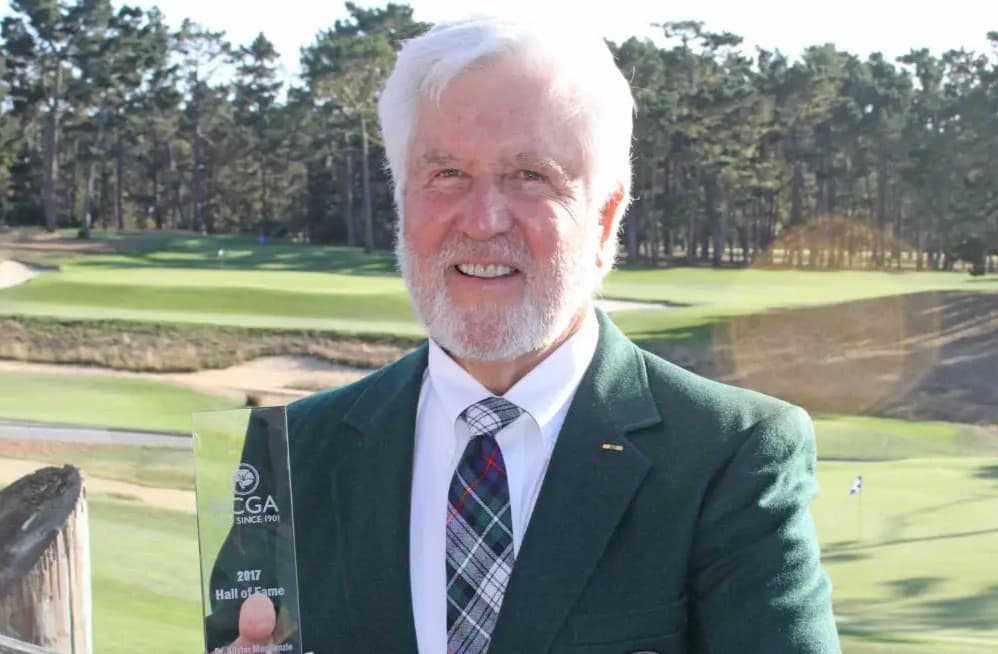
In 2017, when the Northern California Golf Association inducted Alister MacKenzie into its Hall of Fame, Nelson accepted the honor as president of the Society. It was an apt image: one doctor standing in for another, ensuring that the architect who had died more than eight decades earlier was still understood in the place where so much of his American work survived.
What Gary Nelson Left Behind
Gary Nelson died in April 2026. The clearest measure of his influence is not a single monument. It is a set of living institutions: Meadow Club's recovered MacKenzie features, an international Society that still convenes clubs around history and preservation, a public-golf alliance he supported in its defense of Sharp Park, and generations of USF golfers who learned that improvement comes from patient work shared across a team.
His story is a useful correction to the usual idea of influence in golf. Nelson owned no famous design firm and held no permanent national office. His power came from curiosity disciplined into service. He found old evidence, invited the right people into the same room, asked institutions to remember their purpose, and stayed long enough to see knowledge become action.
It began with a board seat he did not take and a gathering he offered in its place. That may be the most Gary Nelson detail of all. He declined the title, built the network, and changed the course.
Sources & Further Reading
University of San Francisco Athletics — In Memoriam: Gary R. Nelson
Northern California Golf Association — The NCGA Mourns the Loss of Dr. Gary Nelson
San Francisco Public Golf Alliance — Remembering the Garys Vandeweghe and Nelson
NCAA Division I Committee on Infractions — University of San Francisco Public Infractions Decision