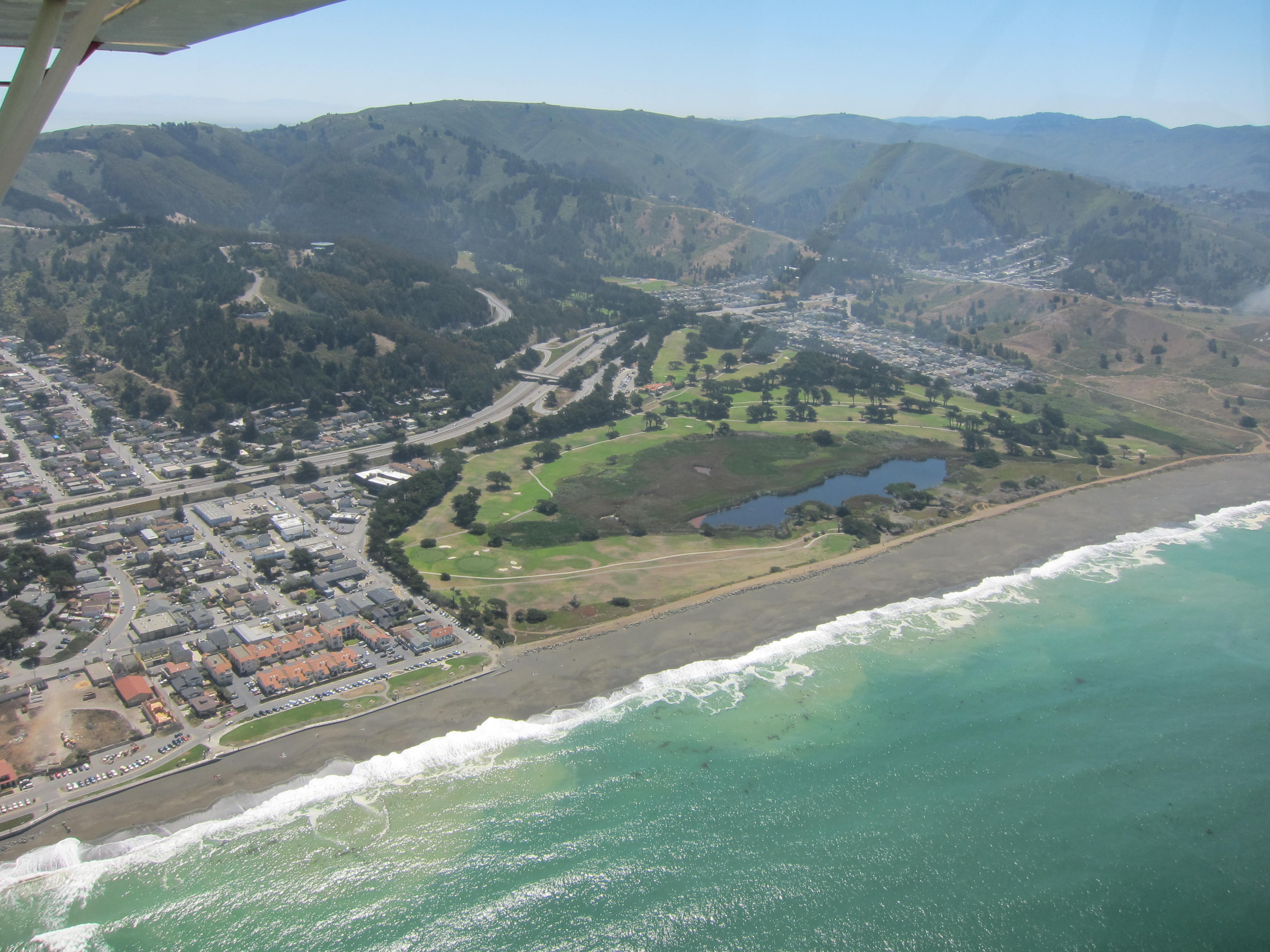
Drive fifteen minutes south of San Francisco on Highway 1, drop over the hill into Pacifica, and you'll find something that shouldn't exist: an Alister MacKenzie golf course — designed by the same man who created Cypress Point and Augusta National — where anyone can tee it up for about the price of a nice dinner. Sharp Park is owned and operated by San Francisco Recreation and Parks, and for more than ninety years it has been the Bay Area's great democratic golf experiment: world-class architecture, seaside land, and a municipal green fee.
The story of how it got here — and how it has survived Pacific storms, a world war, and two decades of courtroom battles — is one of the best golf stories in Northern California.
A Widow's Bequest with Strings Attached
The land itself came to San Francisco as a bequest. George Sharp was a prominent San Francisco attorney who sailed around Cape Horn and arrived in the city in 1849, made a fortune during and after the Gold Rush years, and — in one of history's stranger exits — died in 1882 while pleading a case in a local courtroom. His widow, Honora Sharp, died in 1905, and in her will she left coastal property in what is now Pacifica to the City of San Francisco. In 1917, the executors of her estate conveyed the land — part of what is today a roughly 400-acre park — to the city, on one firm condition: it had to be used as a public park or playground, or it would revert to the Sharp family heirs.
That reversion clause has loomed over the property ever since. The course's defenders — most prominently the San Francisco Public Golf Alliance — argue that it is the legal spine of everything that followed, and that Sharp Park must remain what Honora Sharp's gift required: a place for the public. Whether a golf course is precisely what the clause demands has itself been contested over the years, but the condition's basic thrust — public land, kept in public use — has shaped every fight about the property since.
At the time, the site was hardly promising golf ground. It had been an artichoke farm carved out of barren sand dunes surrounding Laguna Salada, a brackish coastal lagoon that appeared on 1892 USGS survey maps simply as "Salt Valley."
McLaren, MacKenzie, and a No-Fee Bet
Enter John McLaren, the legendary superintendent of Golden Gate Park and a lifelong champion of San Francisco's public lands. In 1927, McLaren proposed building the city's third municipal golf course on the Sharp property. To design it, he turned to Robert Hunter and Dr. Alister MacKenzie — the partnership then at work on Cypress Point, which would open the following year to immediate acclaim.
The arrangement was a calculated bet on both sides. Between 1927 and 1930, Hunter and MacKenzie drafted plans for Sharp Park without a fee, on the understanding that if the plans were later accepted and built, they would be retained as the architects. In late 1930, the San Francisco Board of Supervisors made it official, voting unanimously to hire MacKenzie.
The timing is what makes Sharp Park extraordinary. MacKenzie designed it in the window between Cypress Point and Augusta National — a creative stretch that produced two of the most celebrated courses on earth, and one that many golf historians rank among the finest runs any architect has had. San Francisco got a public course from that same drafting table, in that same burst.
MacKenzie himself set the bar high, promising a course "as sporty as the old course at St. Andrews and as picturesque a golf course as any in the world."
Building a Links Out of a Lagoon
Construction transformed the site. Crews deepened Laguna Salada, converting the brackish lagoon into a freshwater lake, and MacKenzie wrapped his golf holes around and along it. Supervising the work was a murderers' row of golf talent: Robert Hunter Jr.; Chandler Egan, the two-time U.S. Amateur champion who had helped MacKenzie remodel Pebble Beach; and Jack Fleming, MacKenzie's construction foreman from Cypress Point, who stayed on as Sharp Park's superintendent.
The design itself was pure MacKenzie: cross-bunkering, double fairways, multiple tees, mounded greens, undulating fairways, and the optical illusions he loved to build into approach shots. Two of the original holes — the 5th and 10th — were modeled on the famous "Lido hole" concept, offering multiple tees and multiple routes so that bolder lines earned easier approaches. The Spanish Revival clubhouse, completed in 1931 and designed by an associate from Willis Polk's firm, was later decorated with Works Progress Administration murals.
Sharp Park opened to the public on April 16, 1932, at 6,173 yards, par 71. Weeks before opening day, Fleming previewed the course in the San Francisco Call-Bulletin — a February 29, 1932 article in which the man MacKenzie rated "one of the most expert greenkeepers in the country" was candid about the challenges, admitting that "the soil itself is not good" and that salty irrigation water from a beach reservoir left the turf "splotchy," even as he praised the greens. Great architecture, imperfect agronomy: Sharp Park's ninety-year theme was set from day one.
The Ocean Takes Its Share
MacKenzie's original routing ran holes right along the strand — golf against the open Pacific. The Pacific, it turned out, had opinions. Major storms in the early 1940s washed out portions of the oceanfront design, and in 1941 the original beachside holes gave way to an earthen seawall built to protect the rest of the course. Jack Fleming, by then running the grounds, designed four replacement holes on upland ground east of Highway 1, reached by a tunnel under the road — a quirk that survives today and gives the back nine its split personality.
Even so, an impressive amount of MacKenzie survives. Twelve of today's eighteen holes are MacKenzie originals, and fourteen still track his routing — a higher percentage of intact Golden Age architecture than many famous private courses can claim. The seawall itself became an accidental amenity: today it doubles as a walking and biking path, threading the course into the daily life of Pacifica.
The war years touched Sharp Park in a darker way. From 1942 to 1946, the federal government operated the Sharp Park Detention Station on land east of the course, an internment camp during World War II. Its detainees included Japanese Americans as well as German, Italian, Japanese, Mexican, Canadian, and Chinese nationals — among them priests, teachers, community leaders, and newspaper editors whom the government had deemed "dangerous." It is a sobering chapter of the property's history, and part of the full story of this coastline. In happier civic history, Sharp Park — as a public course open to all — also played a role in the racial integration of public golf, a legacy the San Francisco Public Golf Alliance documents alongside pioneers like Ted Rhodes.
Frogs, Snakes, and the Fight for Sharp Park
Sharp Park's modern history has been written as much in courtrooms as on scorecards. The wetlands around Laguna Salada are habitat for two protected species — the California red-legged frog and the San Francisco garter snake — and beginning in the 2000s, environmental organizations filed a series of lawsuits seeking to shrink or close the golf course and return the land to habitat.
The course's defenders — led by the San Francisco Public Golf Alliance, with Ken Venturi famously calling Sharp Park "Dr. MacKenzie's great gift to the American public golfer" — argued that affordable public golf and endangered-species habitat could coexist. City Hall largely agreed. In 2011, Mayor Ed Lee vetoed legislation that would have pushed the course toward National Park Service control. In 2017, the Board of Supervisors voted 9–1 to certify an environmental impact report allowing modifications to three holes to protect species habitat while keeping the course intact — and that same year, Sharp Park was designated a historic resource under the California Environmental Quality Act, formal recognition of its architectural significance.
The habitat work itself has moved forward with approval from the U.S. Fish & Wildlife Service. The frogs and snakes, it turns out, are staying — and so is the golf.
Playing MacKenzie for $51
What does all this history buy you today? Golfweek has ranked Sharp Park among the 50 greatest municipal courses in the United States, and a green fee runs around $51 — for a MacKenzie design that opened a year before Augusta National. Today's course stretches to 6,382 yards, and honest visitors will tell you the conditioning is rugged — "scruffy" fairways, raw and linksy turf — a product of the same sandy soil and coastal water Jack Fleming complained about in 1932.
But that rawness is part of the appeal, and better days may be coming. In 2018, architects Tom Doak and Jay Blasi visited and recommended restoration-minded changes as simple as new mowing patterns to recover the original green shapes, and the Public Golf Alliance continues to push for drainage, irrigation, and restoration funding.
Stand on the holes along Laguna Salada on a fog-softened afternoon — Mori Point looming to the south, the seawall holding back the Pacific, a red-legged frog presumably watching from the reeds — and you're playing one of the last great bargains in American golf: a masterpiece by the sea that a widow's bequest, a park superintendent's ambition, and ninety years of stubborn public devotion managed to keep open to everyone.
Sharp Park at a Glance
Location: Pacifica, CA (owned by San Francisco Recreation & Parks)
Architect: Dr. Alister MacKenzie, with Robert Hunter; construction by Chandler Egan, Robert Hunter Jr., and Jack Fleming
Opened: April 16, 1932 (6,173 yards, par 71)
Today: 6,382 yards; 12 original MacKenzie holes, 14 on original routing
Landmark status: Historic resource under CEQA (2017); Golfweek top-50 U.S. municipal course